
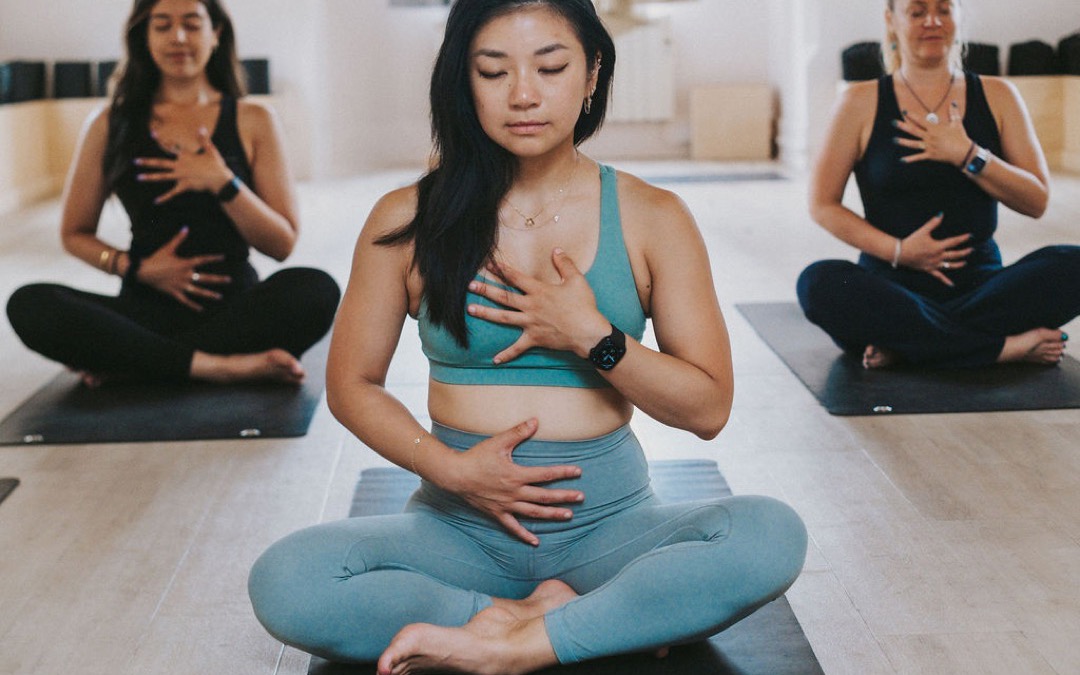

Pranayama and breathing practices
They can vary a lot on how they manipulate the breath, and therefore on the effect they have on our body (and spirit?). They can include variations on pace, including fast breathing like kapalabhati, and slow breathing like ujjayi. They can also incorporate breath holds (called ‘kumbhaka’ in the yoga tradition), as can happen in forms of alternate nostril breathing and box breathing.
My personal interest is slow breathing practices, so I’m only going to talk about those here.
Slow breathing and the vagus nerve
This might be because slow breathing stimulates our vagus nerve, a rather important nerve that helps our brain and our internal organs communicate. The vagus nerve is our largest parasympathetic nerve; when it’s active, it tells our body that it’s safe to do what are called ‘resting state bodily functions’, like digestion (it’s also sometimes called ‘rest and digest’). This is in contrast to what happens when our sympathetic nervous system is active: increased heart rate and breathing rate, to get our bodies ready to fight or run away. As an aside, in general, we want a balance of both states. That balance is also at the heart of Yin and Yang yoga.
Typically, when our vagus nerve is activated, we may notice our breathing and heart rate slowing down, which can make us feel calmer. Research also indicates that slow breathing practices may also help with:
- Lowering our blood pressure
- Our mental health (including symptoms of depression)
- Our immune health – this is more hypothetical based on the fact that the vagus nerve regulates our immune system, so it feels plausible that slow breathing could have effect here too
So, the evidence is promising, although it’s important to remember that nothing is definitive, and that not all claims and practices are equally well-researched.
3 Breathwork Practices You Can Try at Home
Some yoga classes include breathwork, but why limit yourself to class? The beauty of breathing practices is that you just need yourself and 5–10 minutes.
1.Get comfortable – you can practice seated, with a tall spine, or lying down (with something under your knees)
2.Get still – set a timer for 5–10 minutes so you won’t have to keep checking the time
3.Get focused – start with a few moments of tuning into your breath, noticing the feeling of your body breathing
4.Get curious – try one of the practices below
5.Get reflective – at the end, take a moment to tune into how you are feeling, without expecting a change, just be curious – I’m a big fan of jotting down things I notice after practice
1. Coherent breath: even inhale and exhale
How to do coherent breathing
How to do it: Breathe in and out at a pace of 6 breaths per minute, or inhaling for a count of 5 and exhaling for a count of 5 – most of the research has been done at this pace. If that feels too long though, you can switch to a lower count of, say, 4 and 4. The key is keeping the breaths the same length and steady.
2. Ujjayi breath: the audible, victorious breath
How to do it: Breathe in and out with a gentle constriction in the back of your throat; if helpful, imagine the exhale like pushing the plunger of a caffetiere down gently. This is a nice one to bring a visualisation into, imagining your breath travelling up and down your spine – which has the bonus of keeping the mind busy.
3. Cyclic sighing (or the physiological sigh)
How to do it: Take two sips of breath on the inhale, and then a long and steady exhale. The original research included a sighing exhale, but you could also do this with the lips closed.
Guided breathwork sounds better?
Experience the calming effects of slow breathing and mindful movement in a live class. Join our community today and get your first month for just £1 across our London studios.

About Dr Rachel David
Rachel is a science geek, yoga teacher and writer, among other things. She fell in love with yoga after completing her PhD. Since then, she has lived up to her geeky persona by completing a number of trainings with amazing teachers. She teaches vinyasa flow, somatics-inspired flow, yin yoga and yoga nidra, weaving poetry (her other love) into her classes where possible.
An immunologist by training, she is a little bit obsessed by the science of mind–body practices like yoga, in particular the intersection of yoga with mental and immune health (called psychoneuroimmunology). She has written extensively about this and other topics on wellbeing, including sleep – subscribe to the mind–body adventure Substack (https://geekyyoga.substack.com/) and explore Rachel’s extensive archive (geeky.yoga).